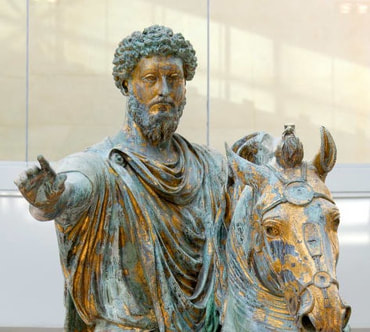
 1,870 years ago, Marcus Cornelius Fronto wrote the following letter (Fronto 5.45) to Marcus Aurelius, then heir apparent to the throne of the Roman Empire:
.Domino meo. Annum novum faustum tibi et ad omnia, quae recte cupis, prosperum cum tibi tum Domino nostro patri tuo et matri et uxori et filiae ceterisque omnibus, quos merito diligis, precor. Metui ego invalido adhuc corpore turbae et impressioni me committere. Si dei iuvabunt, perendie vos vota nuncupantes videbo. Vale mi Domine dulcissime. Dominam saluta. In the translation of C. R. Haines: To my Lord. A happy New Year and a prosperous in all things that you rightly desire to you and our Lord your Father, and your mother and your wife and daughter, and to all others who deservedly share your affection—that is my prayer!In my still feeble state of health I was afraid to trust myself to the crowd and crush. I shall see you, please God, the day after to-morrow offering up your vows.Farewell, my most sweet Lord. Greet my Lady. A happy New Year and a prosperous 2019 in all things that you rightly desire – to all of you! Very much the copyright of The Petrified Muse to whom many thanks. Peter Hulse
0 Comments
Merry Christmas to all readers! This is the man who taught me Latin and Greek at school, reading the Latin poems that he wrote at a Summer school in Sicily. Studying Classical languages keeps you young! You can learn more about the Summer School here.
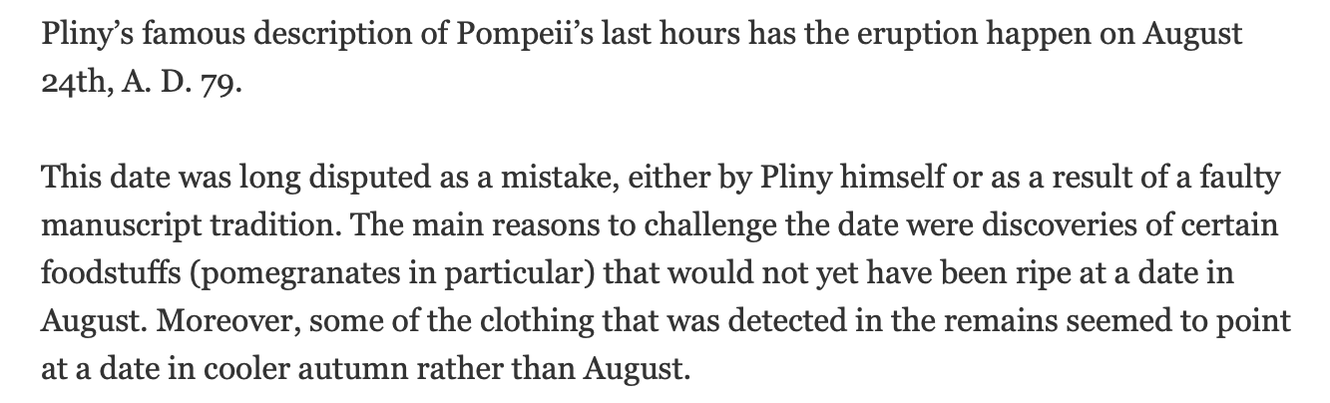 I meant to post this early. However, I've seen nothing about it recently, so perhaps it's not too late: I spent years as a Classics teacher telling children that Pompeii was destroyed by Vesuvius in AD 79. Wrong it seems: In October the news broke that it had actually disappeared in October! All of this is well explained on this excellent site: The (well-named) Petrified Muse! Click the link to read more. The graffito in question has been interpreted as follows: 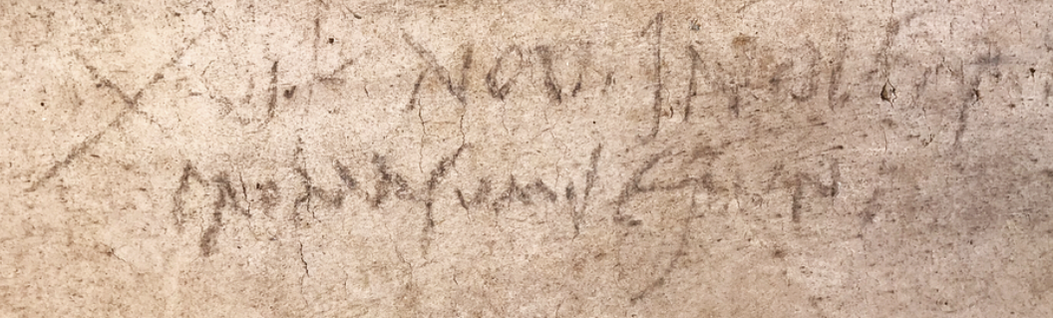  A translation of the above might go something like this: 'On the 16th day before the Kalends of November [i. e. on October 17th] s/he gave free rein to her/his hunger to the max.' (Translation: Peter Kruschwitz). Whether or not this means that the Cambridge Latin Course has got to rewritten, is a matter for discussion. As far as I know (and that could be very wrong), nobody has commented on the actual Latinity of the written of this. Apart from the fact that there doesn't seem to be a good parallel for pro masumis meaning 'to the maximum,' esuritio meaning 'hunger, appetite' is a very rare and literary word. It occurs first in two of Catullus' more scabrous poems: 23.14 and 21.1, where the context makes it clear that the 'hunger' and 'appetite' under discussion may be for more than food! Such an interpretation would put the scribble directly in the tradition of Pompeian graffiti that show the population of Pompeii had a more than passing knowledge of contemporary literature. Was Catullus dining that night in Pompeii?
Peter Hulse Given that the best film ever made about a Greek myth will probably be on the T.V. at Christmas: Jason and the Argonauts, you might be interested in investigating this site (and its preposed activity), if things get a bit desperate round about Boxing day: Click on the image to learn more. Happy' Argonauting'. Be careful in the Black Sea, if you decide to set sail in your Argo: 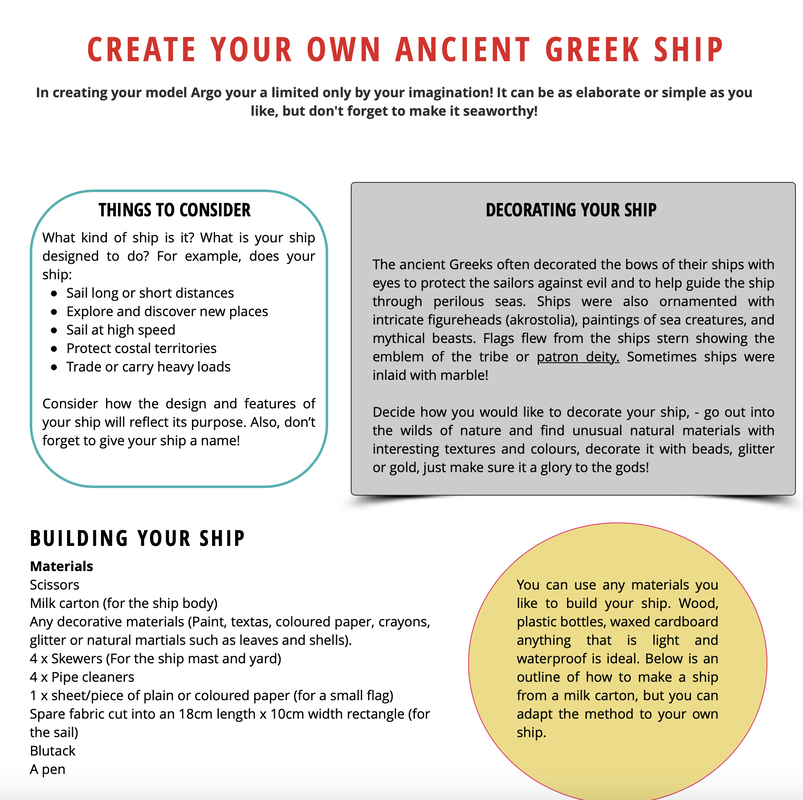 I think these methods have also been applied to the Odyssey: it opens very exciting possibilities: Peter Hulse  Professor Hillner writes:
We are delighted to welcome to Sheffield Profs Ana Bazzan, Silvio Dahmen and Sandra Prado (University of Porto Alegre, Brazil). Ana, Silvio and Sandra are Physicists who have extensively worked on developing network algorithms to understand narrative patterns in both fictional and non-fictional literature (including Alice in Wonderland, the Chanson de Roland, Viking Sagas, and documents pertaining to the court of Holy Roman Emperor Frederik II). They will come to Sheffield from 5-8 November to collaborate with the Leverhulme project 'Gendered Networks in Early Medieval Narratives' based in the History Department, but have also kindly agreed to give a 'masterclass' on 6 November for anyone interested in learning more about mathematical applications of Social Network Analysis (which is currently emerging as a method in Humanities scholarship also). This is a unique opportunity to hear Physicists speak about their work with historical and literary sources and discuss the benefits and challenges of interdisciplinary collaborations between Humanities scholars and Network Scientists. A flyer is attached. Please register your interest by 26 October. N.B. no mathematical knowledge needed at all to participate in this! Ana, Silvio and Sandra will provide the maths. To start off a new season of posts, here's a big bang! It's an old photograph, dating back, I suppose, to March 1944, and I'm afraid I can't acknowledge it properly but it's particularly topical because of the recent new excavations at Pompeii that have uncovered some wonderful things. Including the new graffito. That and the new finds are a topic to which I will undoubtedly return. As always, comments below would be welcome. Peter Hulse  Sheffield Classical Association Events 2018-19 Classical Association AGM Wednesday 8 May 2019 3:15pm Humanities Research Institute, Seminar Room Classical Association Invited Speakers Wednesday 13 March 2019 4:15pm, Humanities Research Institute Owen Hodkinson (Leeds) – “She’s not deadly. She’s beautiful.” Reclaiming Medusa for Millennial Tween and Teen Girls? Wednesday 8 May 2019 4:15pm, Humanities Research Institute Ian Haynes (Newcastle): Recent research on Hadrian’s Wall Tuesday 16 October, 1pm Prof Ergün Lafli (Dokuz Eylül University, Izmir): Archaeology and history of Lydia from the early Lydian period to late antiquity (8th century B.C.-6th century A.D. Tuesday 19 February 2019, 1pm Anna Moles (UCL and British School at Athens Ambassador): Human health and diet at Knossos, Crete: changes from the Hellenistic to Late Antique periods Venue details will be posted here: http://www.sheffield.ac.uk/archaeology/events/lunchtime-lectures Other Talks of Interest Medieval and Ancient Research Seminars Humanities Research Institute (unless otherwise specified) 4:15pm paper begins 5 December 2018 – Jessop West G03 Ulriika Vihervalli (Hist), ‘Gender-based violence and royal women in late Roman Italy’ 13 February 2019 Chris Mowat (Hist), ‘Neither priest nor priestess: Interpreting the Galli priesthood of ancient Rome through queer and non-binary gender perspective(s)’ 27 February 2019 Paul Johnson (Arch): ‘Conceptual geographies: exploring the articulation of social space in Roman Lusitania’ 27 March 2019 – PGR Session Sarah Poniros (Arch) – ‘Experiencing Migration and Diversity in Roman Britain: A Multidisciplinary Approach’ Lewis Dagnall (Hist) – ‘Tribute in Late Antiquity’ You can find the full MARS programme here: http://marcus.group.shef.ac.uk/events/mars/ |
Sheffield branch of the Classical Association, founded in 1920
Archives
February 2026
|


 RSS Feed
